
Ten days go by fast. One day you welcome Bappa home with dhol-taasha and a fresh coat of sindoor on his forehead. Before you know it, the family stands around with a bucket of water. It is time to say goodbye. Maybe you have never done a home visarjan before. Or you just want to get the vidhi and the eco-friendly part right this year. Here is everything laid out simply.
Ganesh Visarjan 2026: The Dates You Need
Ganesh Chaturthi 2026 begins on Monday, September 14. The main, ten-day cycle ends with Anant Chaturdashi. Most sources agree on one thing: the big immersion day this year falls on Friday, September 25, 2026, exactly ten days after Sthapana. That said, not every household keeps Bappa for the full ten days. Plenty of families immerse earlier, on what people call the 1.5 day, 3rd day, 5th day, or 7th day of the festival, depending on family tradition.
Roughly, the shorter cycles fall like this in 2026. The 1.5-day visarjan lands around September 15. The 3rd day falls around September 16. The 5th day comes around September 18. And the 7th day arrives around September 20. If you follow a specific family custom, always double-check the exact tithi timing on a local panchang, since muhurat windows shift slightly by city.
What Visarjan Actually Means
Visarjan is not really a farewell in the sad, final sense, even though it can feel that way when you stand there with the idol in your hands. Ganesha comes into a home or a clay idol temporarily. He stays for however many days the family chooses. Then he returns to his own abode. Immersing the idol in water releases that form back to nature, while the devotion and the blessings stay behind. That is also why the parting chant stays hopeful rather than sorrowful: “Ganpati Bappa Morya, Pudhchya Varshi Lavkar Ya”, meaning come again quickly next year.
The Visarjan Vidhi, Step by Step
Whether you do this at home in a bucket or head to a community pandal, the ritual sequence stays largely the same. Here is how it typically goes.
1. The Uttar Puja (Final Aarti)

Before the idol moves anywhere, do one last, proper puja. Light a diya and incense. Offer flowers, durva grass, modak, and a coconut to Bappa one final time. Sing the Ganesh aarti together as a family, the same way you have every day of the festival. Use this moment to fold your hands and mentally apologise for anything that went wrong or got missed during the celebrations. Ask for forgiveness and for the family’s wishes to come true.
2. Offer Thanks and Seek Blessings

After the aarti, thank Ganesha for his visit and for removing obstacles through the days he stayed at home. Many families also carry the idol in a short round towards each corner of the house before heading out, almost like Bappa takes one last look around before he leaves.
3. The Immersion Itself
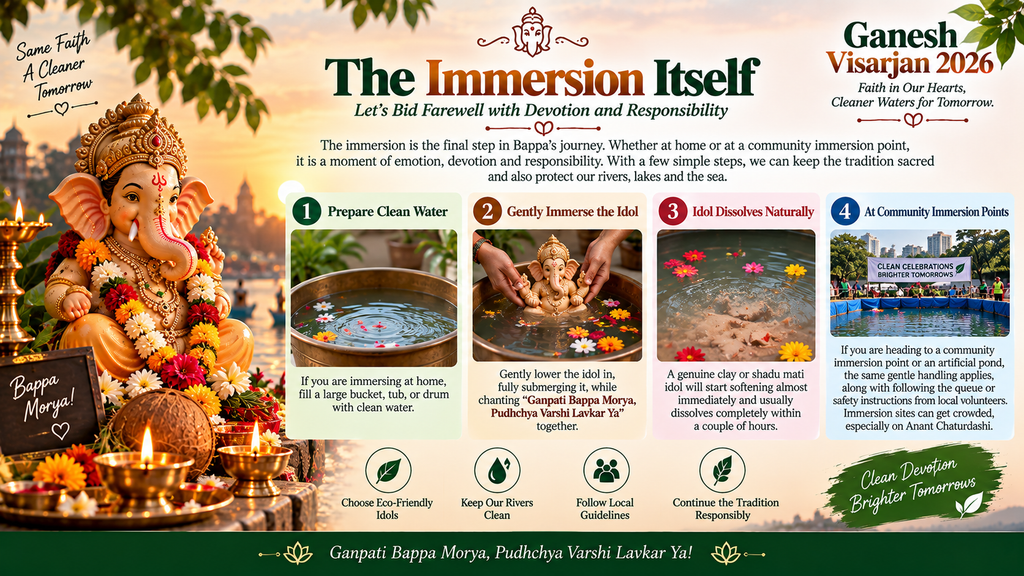
If you immerse at home, fill a large bucket, tub, or drum with clean water. Gently lower the idol in, and fully submerge it, while chanting “Ganpati Bappa Morya, Pudhchya Varshi Lavkar Ya” together. A genuine clay or shadu mati idol starts softening almost immediately and usually dissolves completely within a couple of hours. If you head to a community immersion point or an artificial pond, handle the idol just as gently, and follow whatever queue or safety instructions local volunteers set up. Immersion sites get crowded, especially on Anant Chaturdashi.
Eco-Friendly Visarjan: What Actually Helps

The scale of Ganeshotsav means the immersion habits of millions of households genuinely affect rivers, lakes, and the sea. A few practical shifts make a real difference without taking anything away from the devotion.
Choose a clay or shadu mati idol. Natural clay idols are biodegradable. They dissolve completely in water within hours and return to the earth without leaving any residue behind. Plaster of Paris idols, on the other hand, can take months or even years to break down, and they release chemicals into the water in the process.
Immerse at home wherever possible. A bucket or a large tub at home now works as a widely accepted, low-effort way to do visarjan, especially for smaller idols. It skips the crowd, the travel, and the pressure on natural water bodies entirely. Once the idol dissolves, you can even use the clay-infused water to water plants.
Use designated artificial ponds for larger idols. Most cities now set up artificial immersion ponds and tanks specifically to spare natural lakes, rivers, and the sea. Many municipal bodies, including in Mumbai, also arrange free natural clay and colours for registered idol makers, and they direct idols up to a certain size to these artificial ponds rather than open water.
If you already have a POP idol, consider a symbolic visarjan. Sprinkle a few drops of water on the idol as a symbolic immersion, then retire it respectfully at home or through a proper collection drive. This avoids adding to the pollution load while still honouring the ritual.
Keep offerings biodegradable. Stick to flowers, durva, and fruit for the final offerings rather than plastic decorations or thermocol. Separate out flowers and organic waste afterwards so they can be composted rather than added to the water.
A Few Practical Tips for Visarjan Day
If you head out for a community immersion, leave with enough daylight to spare. Processions and immersion points get busy fast as evening approaches, especially on the final day. Keep the idol steady during transport, ideally on a flat surface rather than held loosely, and carry a cloth or sheet to place under it. If children join the procession, keep a firm hand on them near the water’s edge, since immersion ghats can get slippery with wet clay. And if you do it at home, keep the bucket somewhere the dissolving process will not get disturbed. Plan to give the water and settled clay back to a garden or a potted plant once it is done.
Frequently Asked Questions
1. When is Ganesh Visarjan in 2026?
The main Ganesh Visarjan falls on Friday, September 25, 2026, which is Anant Chaturdashi, the tenth day after Ganesh Sthapana on September 14.
2. Can Ganesh Visarjan be done at home?
Yes. Fill a large bucket or tub with clean water and gently immerse a clay or shadu mati idol at home. This widely followed, eco-friendly method works especially well for smaller idols.
3. How long does a clay idol take to dissolve in water?
A genuine clay or shadu mati idol usually softens quickly and dissolves completely within about two hours of submersion.
4. What should I do if my idol is made of Plaster of Paris?
POP does not dissolve easily and can harm water bodies. Try a symbolic visarjan instead: sprinkle a few drops of water on the idol, then dispose of it respectfully at home or through a collection drive rather than immersing it in a lake or river.
5. What is said while immersing the idol?
Most families chant “Ganpati Bappa Morya, Pudhchya Varshi Lavkar Ya” during visarjan, which means “Hail Lord Ganesha, come again soon next year.”
Planning the full ten days at home? Don’t miss our guides on 15 types of modak to make this Ganesh Chaturthi and the story of how Maharashtra’s grand public Ganeshotsav began with Lokmanya Tilak.