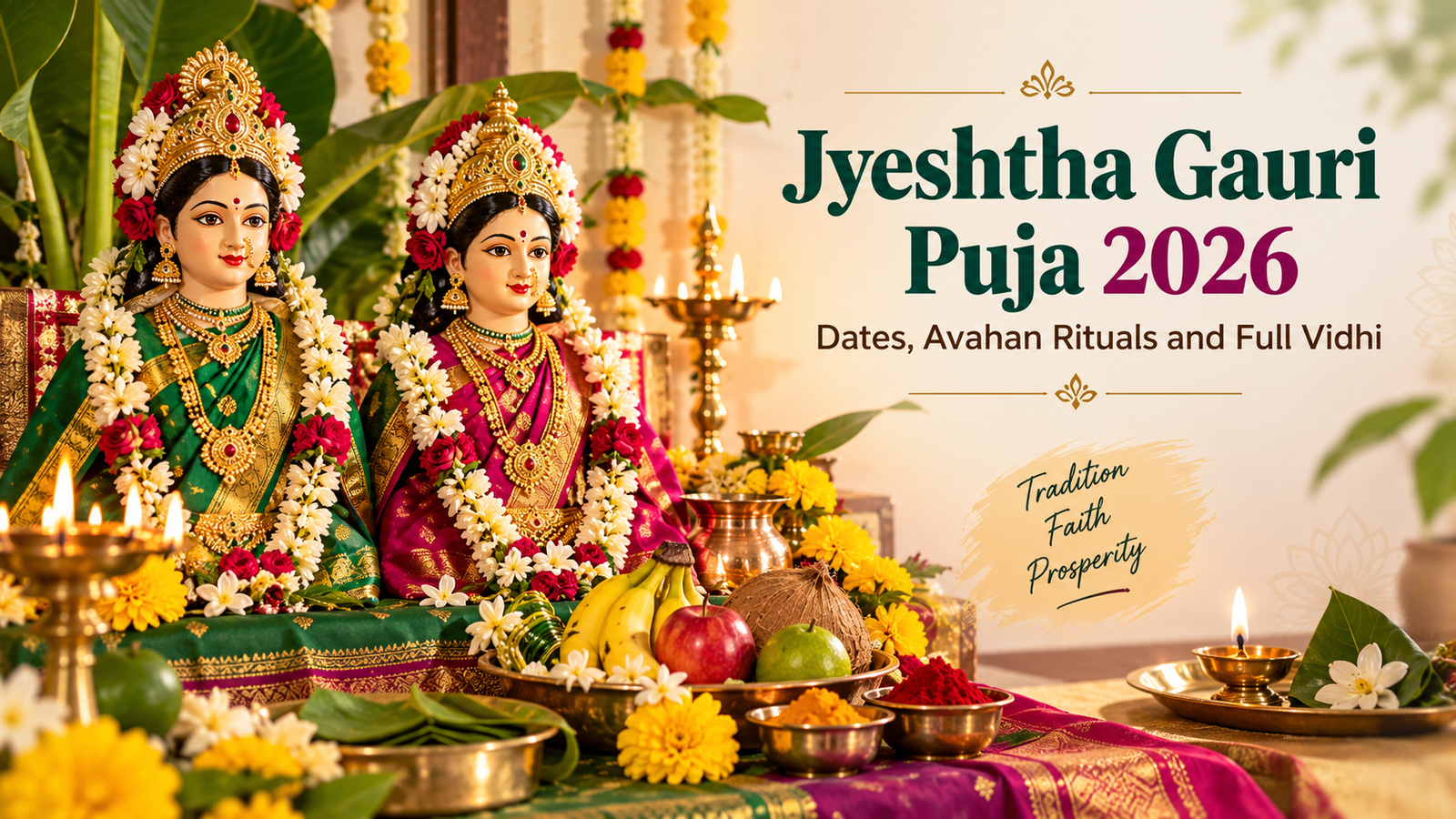
Somewhere between the noise of Ganpati’s dhol-taasha and the quiet of the last aarti, a smaller, gentler festival plays out. Most people outside Maharashtra have never heard of it. She arrives without an idol procession, without fireworks, without anyone shouting her name in the streets. She simply walks in, one small footprint at a time. This is Jyeshtha Gauri, the goddess who visits her son Ganesha for three days every year. If you grew up in a Marathi household, her arrival probably meant more haldi-kumkum, more relatives at the door, and more food than almost any other day of Ganeshotsav.
Jyeshtha Gauri Puja 2026: The Three Dates
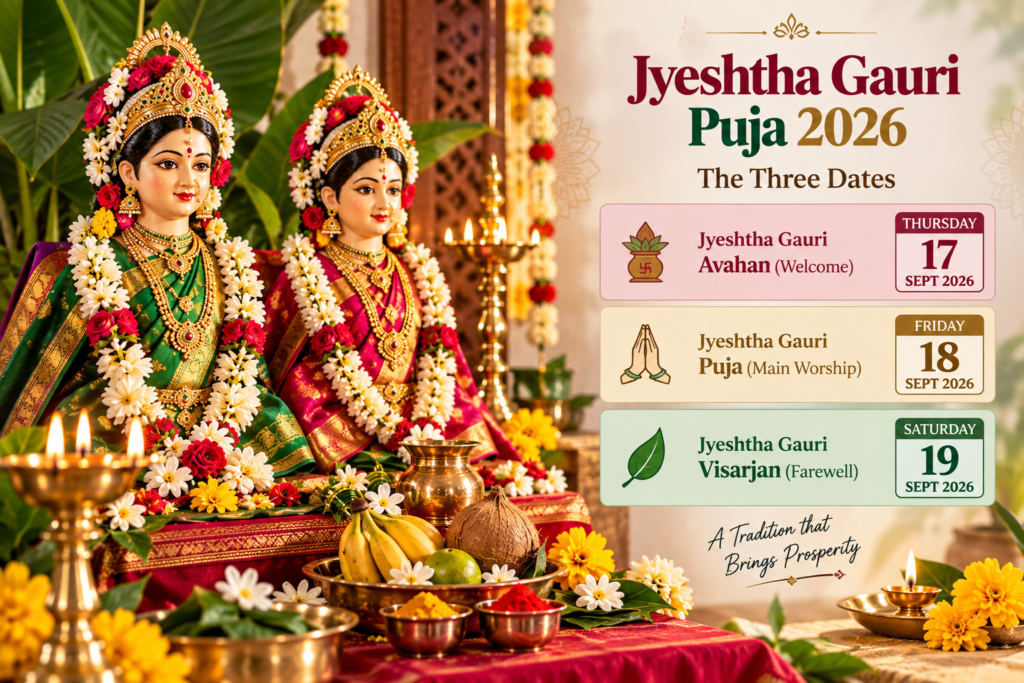
Unlike most Hindu festivals, Jyeshtha Gauri does not follow a fixed tithi. She follows the nakshatra instead. That is why her dates shift slightly every year and never quite line up with the rest of the panchang. The rule stays simple: Gauri arrives in Anuradha nakshatra, receives worship in Jyeshtha nakshatra, and leaves in Mula nakshatra.
In 2026, that works out to:
- Jyeshtha Gauri Avahan (Welcome): Thursday, September 17, 2026, before around 7:52 PM
- Jyeshtha Gauri Puja (Main Worship): Friday, September 18, 2026
- Jyeshtha Gauri Visarjan (Farewell): Saturday, September 19, 2026
This falls right in the middle of the ten-day Ganesh Chaturthi festival, which began on September 14. The exact Avahan cut-off time depends on when the nakshatra changes in your city. Check a local panchang, such as DrikPanchang’s Jyeshtha Gauri Puja page, before you begin, especially if you live outside Maharashtra.
Who Is Jyeshtha Gauri, and Why Does She Visit Ganesha?
Families tell each other a warm story. Jyeshtha Gauri, worshipped as a form of Parvati or Mahalakshmi, comes looking for her son Ganesha, who has already been living in the house since Sthapana. She arrives tired from her journey but overjoyed at the reunion. The family welcomes her the way they would welcome any mother visiting her married child’s home, with decorated doorways, her favourite food, and everyone gathered to greet her.
Most Maharashtrian homes actually bring in two Gauris together, Jyeshtha, the elder, and Kanishtha, the younger. Some families see them as sisters. Others read them as Lakshmi and her elder sister Alakshmi, invited together so that both fortune and misfortune receive acknowledgement rather than one being left out. In coastal Maharashtra, families treat Gauri as Ganesha’s mother, while in other regions she becomes his elder sister or beloved daughter. Whatever version a family follows, one thing stays constant, nobody brings just one Gauri.
Samagri: What You Need Before Gauri Arrives
Most of what goes into a Jyeshtha Gauri puja already sits in a Maharashtrian kitchen or puja cupboard by the time Ganeshotsav rolls around. Still, check the list a day early rather than scrambling on Avahan evening. Keep the following ready:
- A wooden chowki or low platform, plus a fresh red or yellow cloth to cover it
- Gauri masks, idols, or the family’s traditional symbolic form (a purna-kalash, a sugarcane frame, or a bamboo-basket face, depending on the region)
- Rice flour, turmeric, and kumkum for drawing the footprints
- Mango leaves, fresh flowers, and durva grass for the toran and decorations
- A new saree, blouse piece, bangles, and jewellery for dressing the goddess
- Turmeric, kumkum, akshata (unbroken rice), and betel leaves for the puja itself
- A diya, incense sticks, and camphor for the aarti
- Ingredients for the sixteen-vegetable mahanaivedya, along with sweets and savouries for the main puja day
Families following a particular ancestral custom often add a few items unique to their own tradition. Ask an elder in the house what has always been included, rather than relying only on a generic list.
Day 1: Gauri Avahan, Welcoming the Goddess
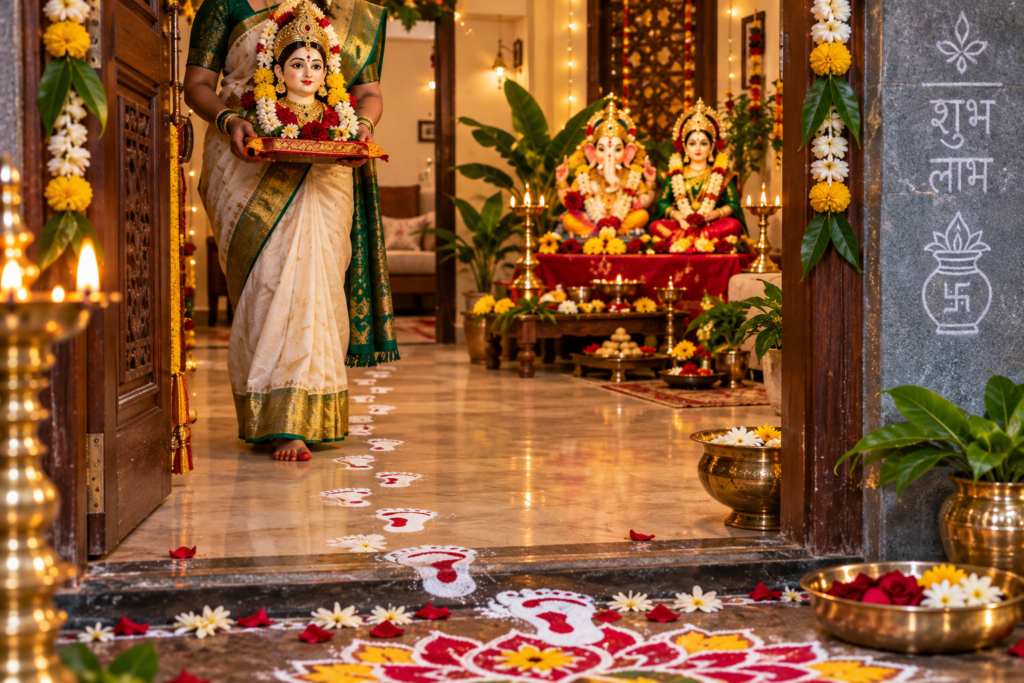
Avahan is not really a puja performed at an altar, it is a welcome performed at the front door. The walking itself is the ritual.
Families start by cleaning the house thoroughly and decorating the main entrance with mango-leaf torans, fresh flowers, and rangoli. Then comes the part everyone remembers from childhood. Someone draws small footprints, called paglya, using rice flour, turmeric, or kumkum, leading from the doorstep all the way to the spot where Gauri will sit. These footprints represent the goddess literally walking into the home.
Near the Ganesh idol, the family covers a wooden chowki with a fresh red or yellow cloth, ready to hold the Gauri masks, idols, or symbolic forms, which vary widely between families and regions. A married woman of the house usually carries Gauri in from the doorway. She stops briefly at the kitchen, the water storage area, and the grain store, so the goddess blesses each one on her way through. The family rings a bell or taps a metal plate to announce her arrival. Once she sits beside Ganesha, a short panchopachar puja follows: a lit diya, incense, turmeric and kumkum applied to the idol, and fresh flowers and akshata offered while the family prays for peace, prosperity, and marital happiness.
Day 2: Jyeshtha Gauri Puja, the Main Worship
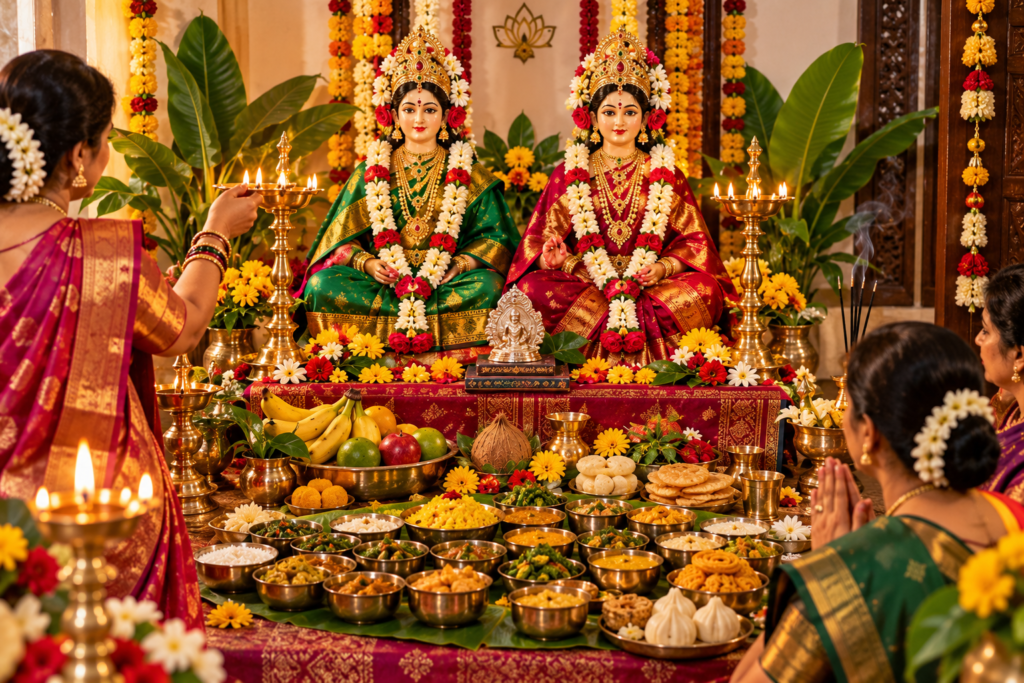
This is the day most people actually mean when they ask about Gauri Puja. The main worship on September 18 involves a full Shodashopachara puja, a sixteen-step ritual with leaves, flowers, and ornaments offered to the goddess in sequence. The family dresses Gauri in a new saree, jewellery, bangles, and flowers, and fills the puja space with fresh diyas and incense.
Food sits at the heart of this day. Families prepare a mahanaivedya, a grand feast that traditionally includes sixteen varieties of vegetables along with sweets and savouries, and offer it all to the goddess before anyone in the family eats. In many Koli households, someone gifts Gauri a new nauvari saree every single year as an unbroken tradition.
The afternoon usually turns social. Neighbours and relatives drop by for darshan. Women gather for haldi-kumkum, apply turmeric and vermilion to each other as a gesture of goodwill, and sing bhajans and folk songs in Gauri’s honour. In many ways, this becomes the busiest and most joyful day of the entire three-day observance.
Day 3: Gauri Visarjan, Bidding Farewell
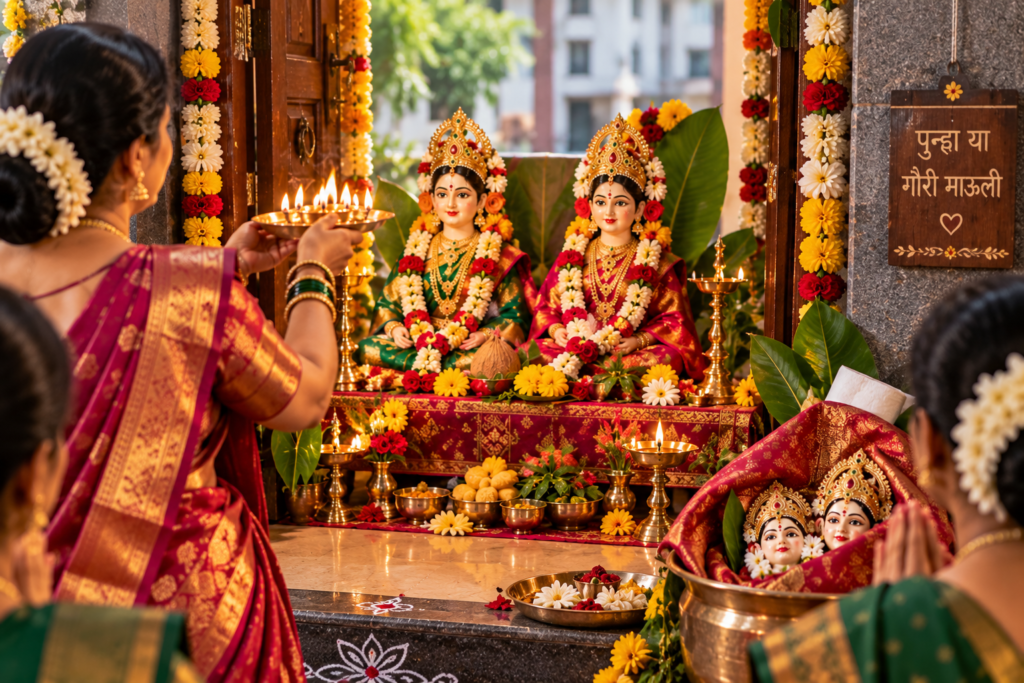
On September 19, the family performs a final aarti and offers naivedya one last time before saying goodbye. Visarjan does not always mean immersing an idol in water the way it does for Ganesha. Many families simply remove the Gauri masks or symbolic forms and store them carefully to reuse the following year, while others immerse a clay representation instead. Either way, the farewell carries the same hope as Ganpati’s own send-off, a prayer that Gauri returns again next year, leaving behind peace, prosperity, and family harmony.
Not the Same as Gowri Habba or Gangaur
People often mix up Jyeshtha Gauri with other Gauri festivals. It helps to keep the three apart. Gowri Habba, also called Swarna Gauri Vrata, is the Karnataka observance held the day before Ganesh Chaturthi, a single-day festival rather than a three-day one. Gangaur, celebrated in Rajasthan, Madhya Pradesh, and parts of North India, falls in the spring month of Chaitra and has nothing to do with Ganeshotsav at all. Jyeshtha Gauri stands apart from both, a three-day guest observance tied specifically to Ganesha’s stay at home, with idols or masks installed rather than a fasting-only ritual, and no compulsory vrat attached to it.
The form Gauri takes also changes by region within Maharashtra itself. Some families use a simple metal mukhavata, or mask, mounted on a bamboo or sugarcane frame and dressed like a full figure. Others bring home a decorated kalash with a coconut on top, treated as Gauri’s face. In parts of Konkan and among Koli communities, families often keep a more elaborate clay or metal idol, dressed each year in a fresh nauvari saree. No version counts as more correct than another, the ritual and the devotion behind it matter far more than the exact form the goddess takes in a particular home.
The Story Behind Jyeshtha Gauri
The most commonly told Jyeshtha Gauri vrat katha centres on a poor Brahmin who could not afford even the basic items needed to perform the puja. Moved by his devotion despite his poverty, Goddess Gauri appeared before him as an old woman and helped him complete the worship, then blessed his household with prosperity afterwards. Families retell the story every year as a reminder that devotion matters far more than the scale of the offering.
Frequently Asked Questions
1. When is Jyeshtha Gauri Puja in 2026?
Gauri Avahan falls on Thursday, September 17, the main Puja on Friday, September 18, and Visarjan on Saturday, September 19, 2026.
2. Why do families bring two Gauri idols instead of one?
Most Maharashtrian homes welcome Jyeshtha and Kanishtha together as sisters, or in some traditions as Lakshmi and Alakshmi, since the pair is believed to arrive and leave together.
3. What is offered in the Jyeshtha Gauri puja thali?
A typical thali includes a purna-kalash decorated with mango leaves and coconut, red roses, durva grass, turmeric-kumkum, betel leaves, bangles, and the sixteen varieties of sattvic naivedya prepared for the main puja day.
4. Does Gauri Visarjan always mean immersing the idol in water?
Not necessarily. Some families immerse a clay representation, while others simply remove the masks or symbolic forms and preserve them respectfully for the next year’s festival.
5. Who is Jyeshtha Gauri believed to be?
She is worshipped as a form of Goddess Parvati or Mahalakshmi, seen either as Ganesha’s mother in coastal Maharashtra or as his elder sister or daughter in other regional traditions.
Following the full ten days at home this year? Check out our guides on 15 types of modak to make this Ganesh Chaturthi, the complete Ganesh Chaturthi puja vidhi and daily aarti, and how to perform Ganesh Visarjan the eco-friendly way once the festival ends.